
Emerging and traditional audio tech together at IBC 2025
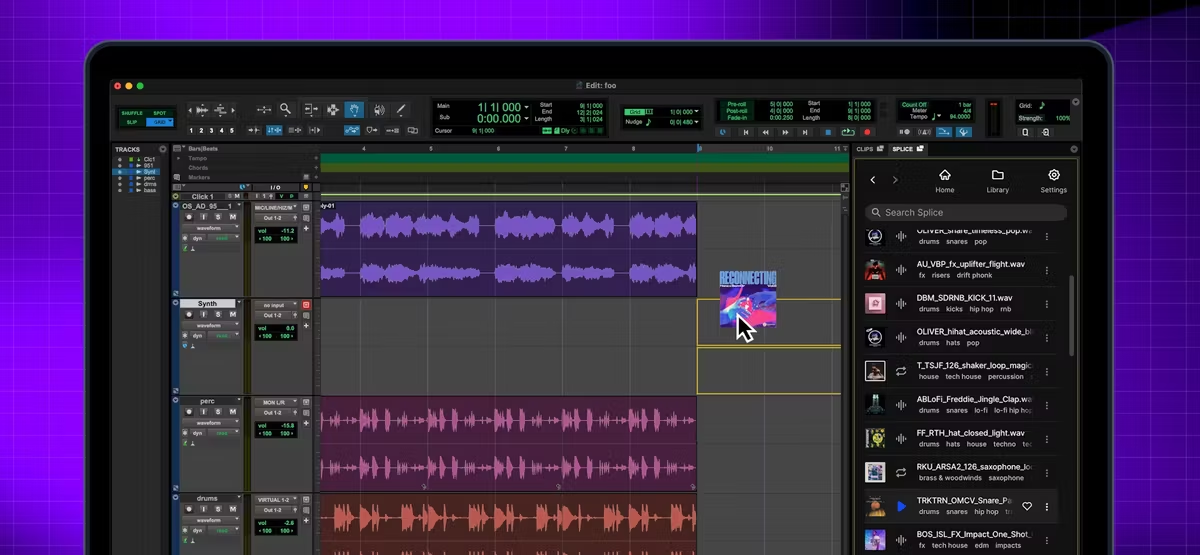
This year's IBC saw significant audio related announcements on its first day. The highlight was Avid demonstrating a specially configured Pro Tools system integrating UHD World Association (UWA) Audio Vivid spatial sound technology. There were also three major console launches: Calrec's latest Argo M model, the AEQ CAPITOL IP PLUS and the Evertz Studer Vista in VUE virtual mixing desk.
Introduced as the first audio coding standard based on AI technology, Audio Vivid has been designed as a 3D immersive specifically for Ultra HD (4K) video. It is an open format and is now able to work with Avid's spatial SDK (software development kit), making the UWA among the first trade bodies to incorporate this feature into its standards.
The collaboration between Pro Tools and Audio Vivid can be seen on both Avid's stand and UWA's demonstration booth, which features an Audio and HDR Vivid immersive room. UWA will be hosting a Happy Hour from 4pm to 6pm on Stand 3C.48 today (13th September) that will include a video presentation of how Audio Vivid can be incorporated with the Avid SDK. "The successful integration of Audio Vivid into the Pro Tools ecosystem marks an important milestone in advancing immersive audio technology from standard-setting to deep industry adoption," comments Vincent Zhang, general secretary of the UWA. "It [also] opens a vital channel for Audio Vivid to establish its global market presence and connect with the international professional creation ecosystem."
Chris Winsor, Avid's director of product management, adds, "Bringing Audio Vivid into Pro Tools via our immersive SDK reflects Avid's commitment to open standards and innovation. This integration enables native support for object-based spatial audio workflows, giving professionals powerful new tools for immersive production." Audio Vivid for Pro Tools will be introduced officially "soon" but, in the meantime, Avid is also using this year's IBC to launch version 2025.6 of its digital audio workstation.
The new release continues Avid's ongoing programme of integration with third party systems and plug-ins. Key among these is native operation with samples, loops and other sounds from the Splice library (pictured above). This new feature enables users to search, audition and then import Splice content into their projects. Other plug-ins now supported by Pro Tools through version 2025.6 are the Non-Lethal Applications Cue Pro ADR and cueing program and The Cargo Cult's Matchbox 2.0 with Smart-Conform for automatic re-conforming of projects in both Pro Tools and video editing systems such as Media Composer.
Calrec regularly uses IBC to showcase its new consoles and continues that tradition this year with the latest model in the overall Argo M range. The 48-fader console is the final addition to both the Argo M range and the Argo series. The Argo M family now comprises desks with 28, 36 and 48-fader strips and features 356 channels of DSP, plug-and-play SMPTE ST 2110 and cloud capability, plus connectivity to Calrec's ImPulse processing core. Also on show are the Argo S 48-fader desk with updated software, including enhanced routing features; True Control 2.0 for remote operation of any console from anywhere, being shown with the Type R modular IP mixer; and the ImPulseV virtual DSP core.
AEQ is covering TV and radio with the CAPITOL IP PLUS console. Designed for on-air work in both media, the new mixing system combines a digital control surface with a touchscreen and IP connectivity. Features include four-band parametric equalisation, filters and dynamics, plus a total of 32 sum buses for programme outputs, ancillaries, monitoring and clean feeds. There is also the option for remote operation through the Virtual Capitol app, which creates a parallel controller on a PC.
Studer is a long-standing name in broadcast mixing consoles. From being an independent company it was bought by Motor-Columbus in 1990, which sold its controlling share to Harman four years later. Since 2021, Studer has been a brand of Evertz Microsystems, which continues to produce the Vista 1 Carbon, Vista X, Vista Bravo, Vista V and Micro Series ranges. The latest development is Vista in VUE, which combines the Vista control surface and Infinity DSP into Evertz's VUE user interface.
The result is a software-defined mixer, which allows multiple VUE touch panels able to run a Vista system over a LAN or WAN. Virtual audio mixing consoles have found favour among some sound engineers but there are many who still prefer to mix using physical faders. Not to alienate this group of users, Evertz offers the BRAVO-WAVEBOARD and BRAVO-WAVEBOARD Mini control panels, with 8 and 4 faders respectively.
The audio console is continuing its development but, although virtualisation is certainly an established feature now rather than a specialist niche or emerging trend, it remains true to its roots. And while immersive audio for TV, at least, is still not widely implemented, developments such as Audio Vivid and its adoption by major technology players like Avid may begin to push it further towards general deployment.
